
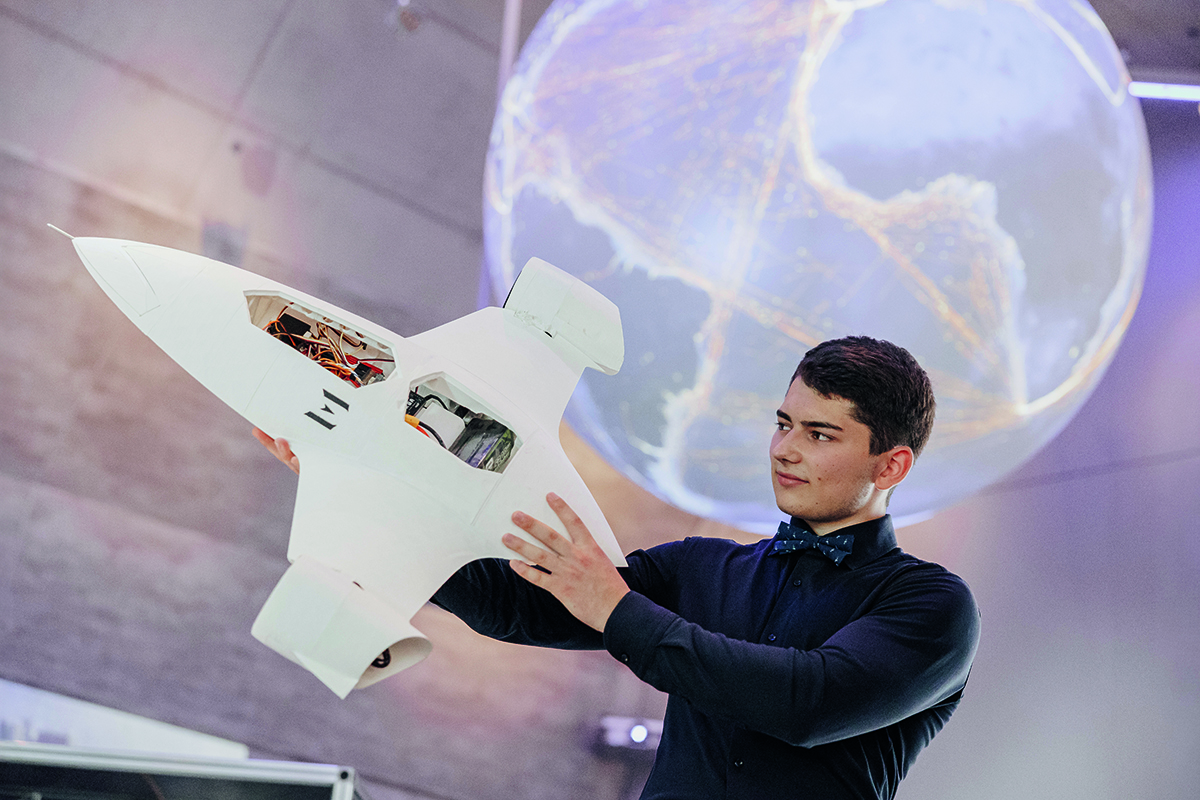
FAU student Ediz Osman is passionate about aviation technology and even builds functional jet prototypes, which helped him to win the national finals of “Jugend forscht.”
“The surface area increases quadratically and the weight cubically. So you always need significantly more power than the additional surface area you gain.” When Ediz Osman talks about the relationship between weight and transport surface during the takeoff of one of his self-built jets, his eyes light up. The 21-year-old is studying mechanical engineering at FAU and has been building model airplanes since childhood. He is currently working on an environmentally friendly VTOL jet, short for “Vertical Take-Off and Landing.” Aircraft with the ability to hover already exist in principle. But the innovation of Osman’s work is that he is designing jet aircraft that can hover. He entered the “Jugend forscht” competition with a prototype that he designed himself and advanced through all stages of the competition. First, he won the regional and state championships in Bavaria and ultimately won the national finals in the technology category. Part of the prize includes an invitation to the “European Union Contest for Young Scientists.” “My goal from the beginning was to become the national champion. But I also know that my model is difficult to implement in reality,” he reflects. When he talks about fluid dynamics or power electronics, it’s immediately clear: Ediz Osman has delved deeply into the subject matter. “I taught myself everything using books, YouTube, and trial and error.”
What’s special about his project: The engines of his VTOL models can swivel 90 degrees, allowing the machine to both hover like a helicopter and fly like a jet. He 3D-printed, wired, and tested everything in his parents’ basement. “From the very beginning, I paid close attention to maximum efficiency when choosing materials. They have to be affordable, as well as light and stable – otherwise they won’t even take off.” VTOL jets don’t need a runway for takeoff and landing, which means they can reach any destination within their range, independent of airports.
Big visions for the future
Osman was born in Bulgaria, has Turkish roots, and came to Germany with his family when he was eight years old. To learn German in another setting besides school and to make connections, he went to an adventure playground. There, a helper made paper airplanes with him, and his passion for technology began. “I wanted to know how airplanes work, so I read everything about them.” Today, he speaks fluent Turkish, Bulgarian, English, and German – a huge advantage at international competitions. “Sometimes I switch languages in the middle of a sentence if a technical term comes to mind faster in another language.”
At FAU, he is now expanding his theoretical foundation. “Mechanical engineering in Erlangen is especially broad and helps me advance my ideas.” He is especially fascinated by the subjects of materials science and production engineering. Both subjects have a direct connection to his work with the models. He uses practical seminars to optimize his models. “Someday, I want to build a real VTOL jet that allows people to travel sustainably and efficiently.” When he’s not tinkering or studying, Osman rides his road bike and draws to unwind. Looking to the future, he is already thinking about incorporating hydrogen cells and solar power into his models. For a third-semester student, that’s quite an altitude.
Sebastian Schroth
This article is part of the FAU Magazine
The third issue of the FAU Magazine #People is once again all about the people who make our FAU one of the best universities in the world. The examples in this issue show how lively and diverse our research is, the commitment of our students, and the work in the scientific support areas.
Highlight is certainly the new research cluster “Transforming Human Rights.” Or you can follow our scientists into laboratories and workshops, where they make potatoes climate-resistant, teach robots social behavior, or reconstruct ancient ships and cannons. At FAU, students are developing vertical take-off aircraft or impressing with outstanding performances at the Paralympics. And let’s not forget the people who work at our university or remain closely connected as FAU alumni. Visit the Children’s University with them or watch a TV series with an FAU alumna and Grimme Award winner.
- File Name
- FAU_Magazine_2025_2026
- File Size
- 3 MB
- File Type